
Context
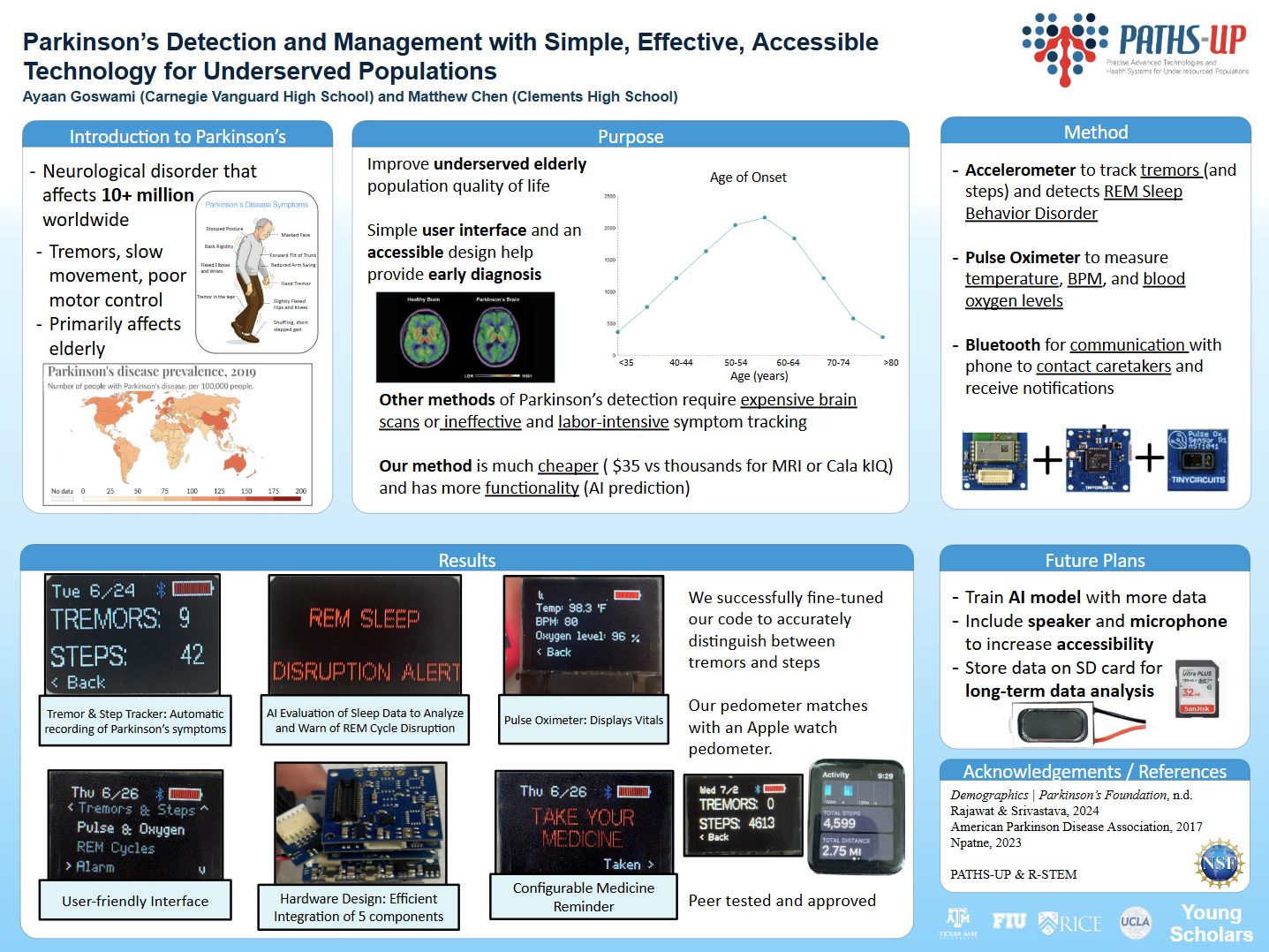
In the summer of 2025 I was one of 12 high school students selected for the PATHS-UP Digital Health Young Scholars program at Rice University, a federally funded program focused on health technology for under-resourced populations. My teammate Matthew Chen and I had a few weeks to design and build something real. We picked Parkinson's disease.
Parkinson's affects more than 10 million people worldwide, mostly older adults. Diagnosing and monitoring it tends to depend on expensive brain scans or tedious manual symptom tracking. We wanted something cheap and simple enough that it could actually reach the people it is for.
What we built
A wrist-worn device made from three TinyCircuits boards:
- an accelerometer to count tremors and steps, and to watch for signs of REM sleep behavior disorder,
- a pulse oximeter for temperature, heart rate, and blood oxygen,
- Bluetooth to talk to a phone, so caregivers get notified.
The parts came to about $35. The alternatives we compared against on our poster were MRI and devices like the Cala kIQ, which cost thousands. On top of the sensors, the watch runs an evaluation of sleep data that warns about REM cycle disruption, and a configurable medicine reminder.
Fig. 1. The watch, rebuilt from our poster
TREMORS: 9
STEPS: 42
‹ Back
The hard part
The hardest technical problem was telling tremors apart from steps. Both show up as repeated acceleration, so a naive counter counts everything. We tuned the code until it separated the two reliably, then checked the step counter against an Apple Watch on the same walk: 4,613 steps on ours, 4,599 on the Apple Watch.
The harder problem wasn't technical, though. We kept asking who would actually use this. A caregiver managing a parent with Parkinson's is not going to read a technical manual, so the interface had to work the first time, with no explanation. That one constraint shaped the alert thresholds, the display, and how simple the hardware setup needed to be. Designing for someone in a stressful situation is completely different from building something for yourself.
Presenting it
We presented at the PATHS-UP Digital Health Symposium at Rice to faculty, graduate students, and people who had spent decades in the field. It was my first time explaining technical work to that kind of audience. What I took away is that you have to own what you built, including the parts you would do differently.
What we would do next
Our poster listed three next steps: train the AI model on more data, add a speaker and microphone to make the watch more accessible, and store readings on an SD card for long-term analysis. I kept coming back to Parkinson's after the program, through the voice instead of motion. That turned into NeuroVoice.